You’ve opened their chat for the fourth time. What would you ask a mate doing the same thing?
Try it tonight
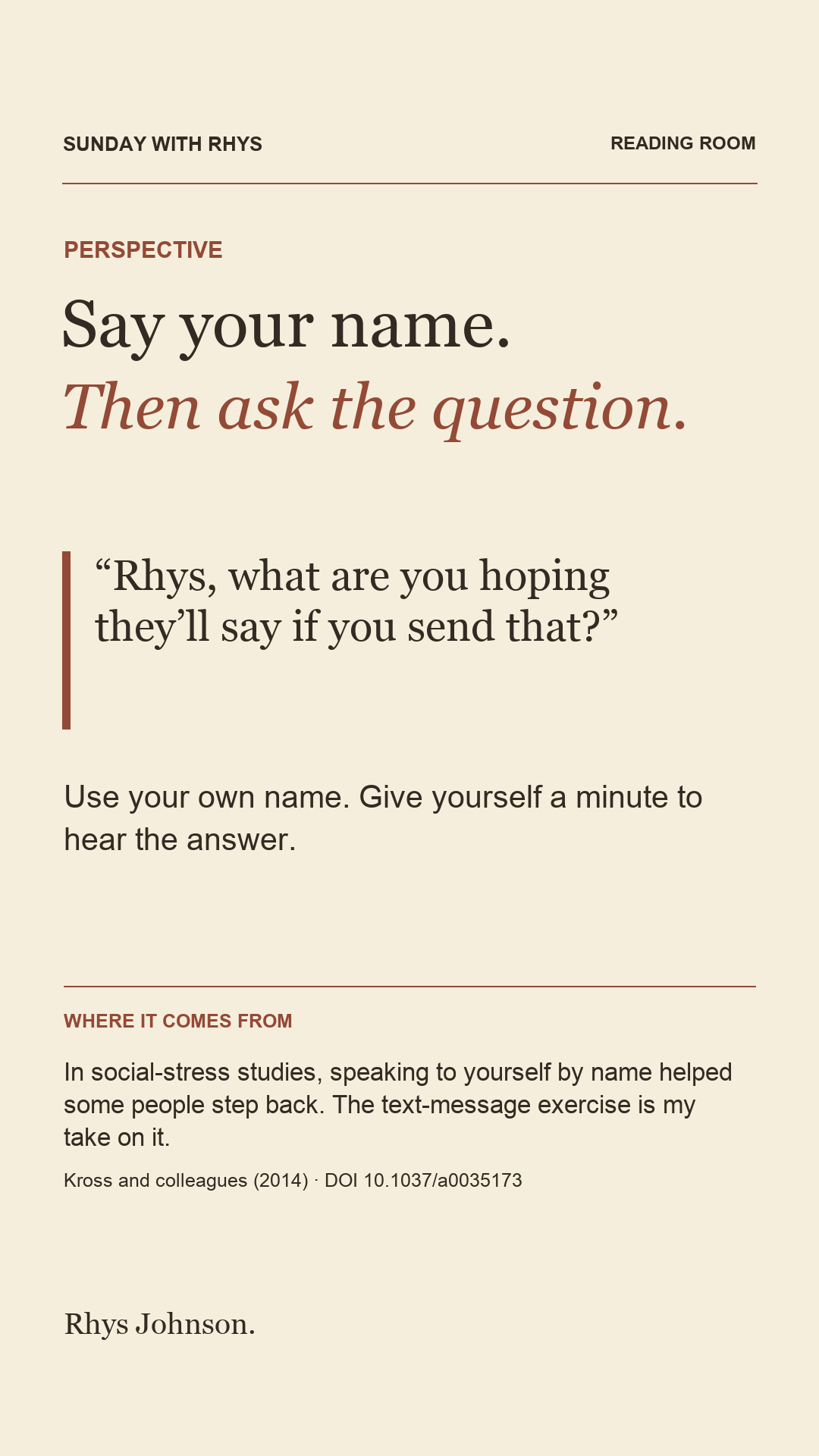
Use your name in one question. Mine would be, “Rhys, what are you hoping happens if you send this?” Give yourself time to hear the answer.
The study behind it
How we talk to ourselves
Ethan Kross, PhD, a psychology professor at the University of Michigan, and colleagues studied 585 people across seven studies. In stressful social tasks, including a speech, people who reflected using their name or words like “you” felt less distress. Independent observers also rated their performance more highly.
The researchers studied social pressure. The chat question is my way of trying their idea in ordinary life. Its effect after a breakup is still an open question.
There’s a difference between “I wish I’d handled that better” and letting one messy night stand in for your entire character.
Try it tonight
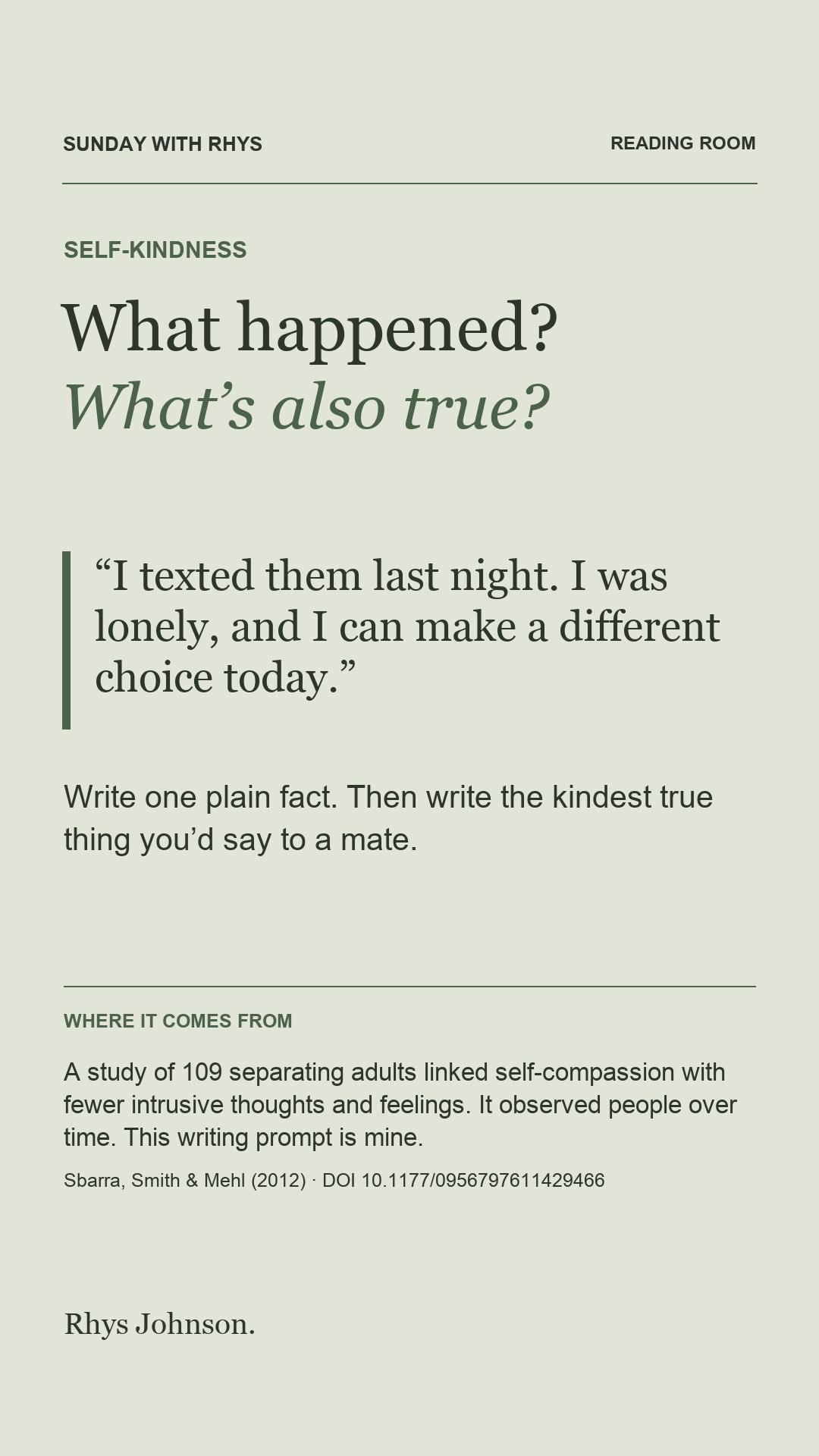
Write one sentence about what actually happened. Follow it with the kindest true thing you’d say to a mate in the same shoes. Keep both sentences.
The study behind it
How people spoke about a separation
David Sbarra, Hillary Smith and Matthias Mehl studied 109 adults going through marital separation. Four observers listened to short recordings. The people they rated as more compassionate towards themselves reported that the separation intruded less on daily life. The association was still there up to nine months later.
Sbarra holds a PhD from the University of Virginia and is a professor of psychology at the University of Arizona. His team observed people over time. The design leaves open whether practising kinder self-talk changes recovery. The two-sentence exercise is mine.
“I’ll look after myself this weekend” sounds good on Friday. By Saturday morning, it helps to have a time, a place and one thing to do.
Try it this weekend
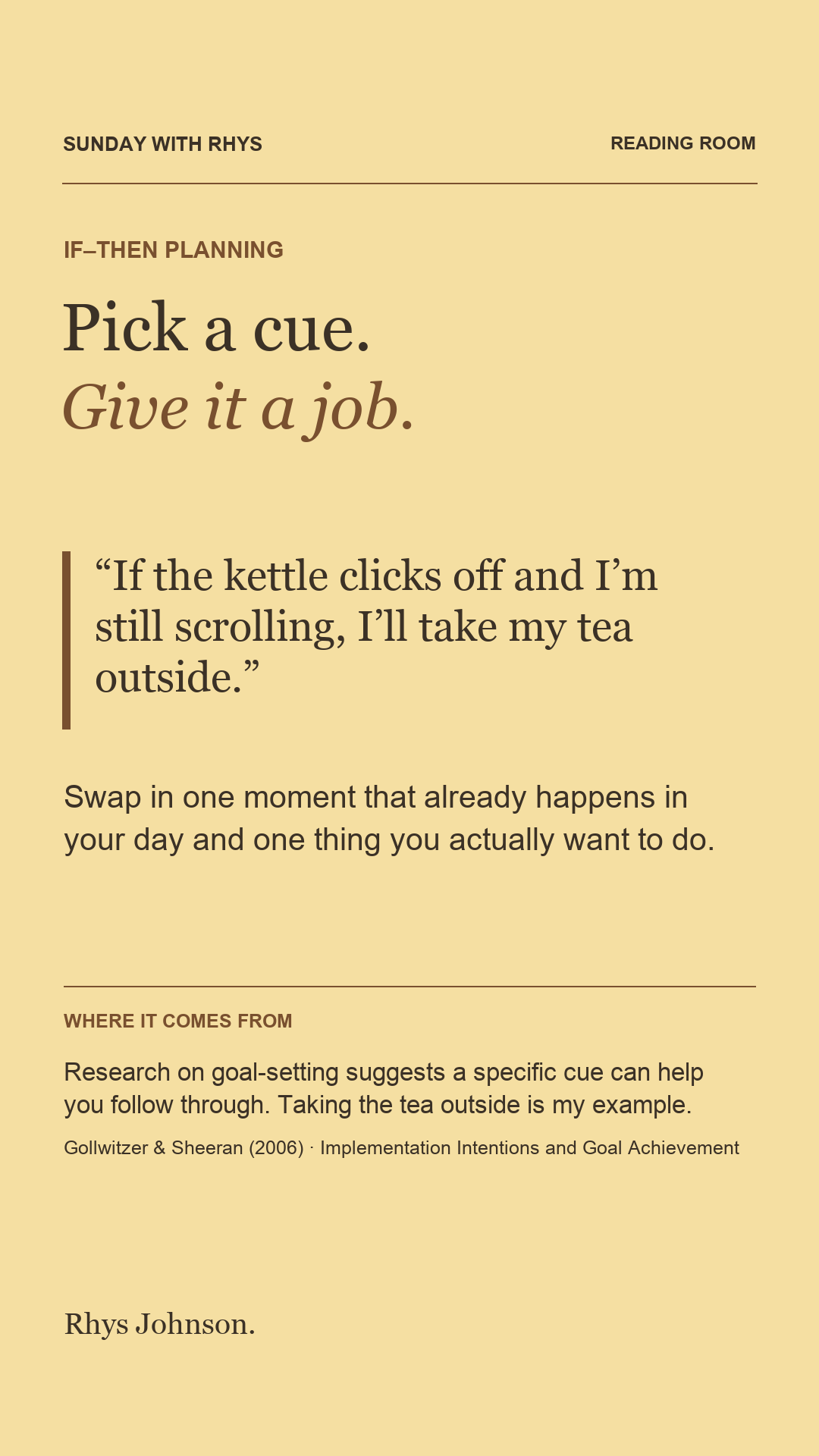
Finish this out loud. “If I’m still scrolling when the kettle clicks off, then I’ll put my phone down and take my tea outside.” Swap in something you actually want to do.
The study behind it
Making a cue do some of the work
Psychologists Peter Gollwitzer and Paschal Sheeran pooled 94 tests in 2006. People followed through more often when they linked a recognisable situation to a specific action. A later review of 642 tests found larger benefits when people wanted the goal and rehearsed their plan.
The reviews covered many kinds of goals. The result concerns following through on an action. How you’ll feel after taking your tea outside is a separate question.
“we have to allow ourselves to be seen, really seen.”
Brown, a research professor of social work at the University of Houston, is talking about connection. Think of one person who’d like to know how you really are. What would you say if you skipped “yeah, all good”?
“the ability to stay connected to one's self in the presence of another.”
Psychotherapist Esther Perel talks about keeping a sense of yourself when you love someone. That leaves a good question after a split, too. What’s one thing you used to do purely because you liked it?
The bit I’d pull out for a Sunday night is Rule 2. If a mate were coming over after a rough week, you’d probably sort some food and put clean sheets on the spare bed. Which of those things could you do for yourself tonight?
I write the exercises and pick the sources. Each study link opens the original research. The talks and books are here because they gave me a question worth asking. The speakers and researchers are cited for their published work. Editorial responsibility sits with me.
If I’ve missed something, reply to a Sunday letter with the passage and the source you think I should read. I’ll check it and date any material correction here.